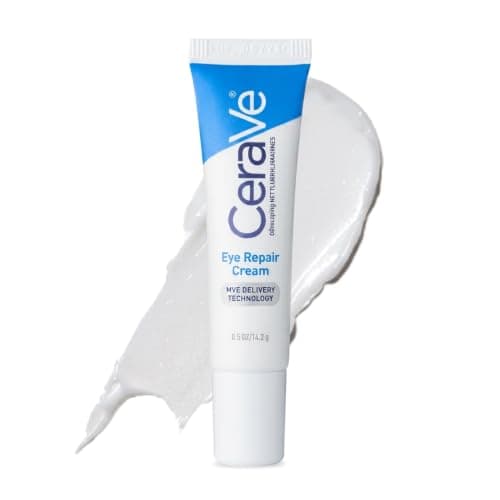
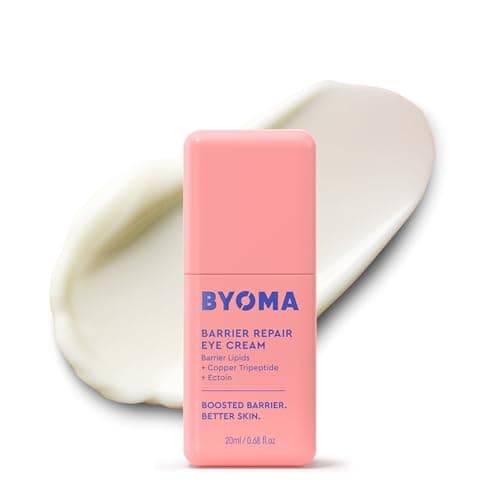
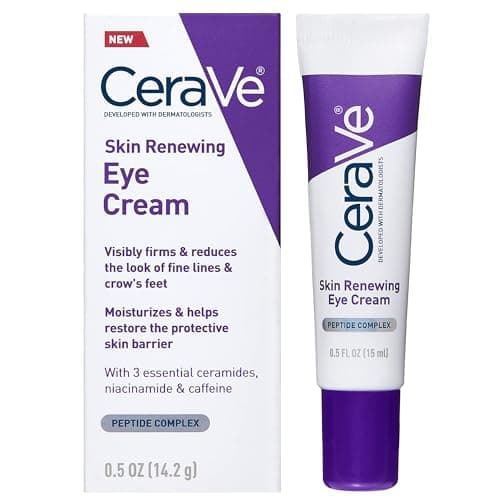
The best ceramide eye cream under $20 is CeraVe Skin Renewing Eye Cream— and the useful finding is that it is also the best-scoring eye product on this site at any price. The budget pick is CeraVe Eye Repair Cream, the cheapest thing on the page. If you want the biggest pot for the money, that is BYOMA.
Here is why this band is worth a page of its own. At our most recent price check, the eye-area products we track split into two groups with nothing whatsoever in between: five between roughly $11 and $18, and six between roughly $45 and $80. There is no eye product on this shelf at $25, or $30, or $38. That is not a gentle price gradient where you trade a little money for a little performance — it is a cliff, and $20 is the only band that divides it meaningfully.
So the question this page answers is not “what is the best cheap eye cream”. It is: what does crossing that cliff actually buy you? Read the ingredient lists on both sides and the answer is consistent. The premium tier buys a second active— encapsulated retinol, retinal, a peptide complex — and a brand. It does not buy a deeper ceramide list. The cheapest pick on this page publishes more named lipids than most of the $45-plus tier does, and our top pick here outscores every one of them. If you want a retinoid around your eyes that is a real reason to spend, and we rank that tier on the best ceramide eye creams. If you want barrier support, this band is where you are done.
How we ranked these
Every pick had to be under $20 at the live price, which is the only hard gate. After that the order comes from four things, in this order:
- Does it name its ceramides?“Ceramides” on the front of a box is marketing; “ceramide NP, AP and EOP” in the INCI is a formulation decision. Only one pick on this page names three and pairs them with cholesterol, and it leads for that reason. One pick names none at all, and it is ranked last and labeled.
- Cost per use, not cost per pot.Eye creams are sold in a near-universal 0.5 oz pot, and you use a rice grain per eye. Two pots at the same price can differ by a third in volume — the BYOMA pot is 0.68 fl oz against the 0.5 oz default, which is the best cost-per-ounce of any cream here. That matters more than the sticker price, which is why this page is ordered differently from the main eye roundup.
- Is the second mechanism eye-area appropriate?Niacinamide and caffeine are fine here. A strong retinoid on eyelid skin is a decision, not a freebie, and at this price band you mostly are not being offered one — which, for most people starting out, is a feature.
- Fragrance and essential-oil load. Eyelid skin is the thinnest on the body, so a fragrance that a cheek tolerates can be a problem here. Fragrance-free picks rank above scented ones at equal disclosure.
The five, side by side
| Pick | Best for | Pot size | Ceramides disclosed | Second mechanism |
|---|
| CeraVe Skin Renewing Eye Cream | Dry, crepey under-eyes — top pick | 0.5 oz | 1, 3, 6-II + cholesterol | Peptides + niacinamide |
| CeraVe Eye Repair Cream | The cheapest competent option — budget pick | 0.5 oz | Ceramides + niacinamide | Marine and botanical complex |
| BYOMA Barrier Repair Eye Cream | The most product for the money | 0.68 fl oz | Ceramide complex (types not published) | Peptides |
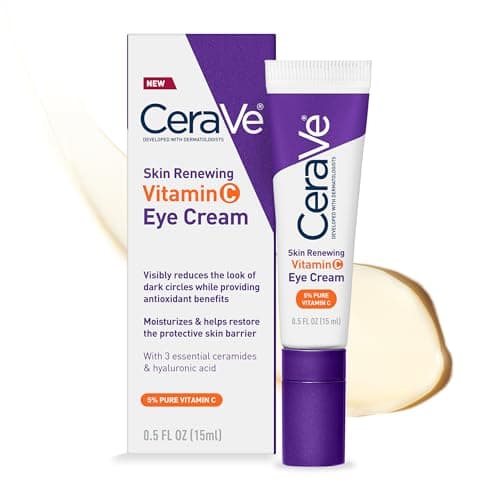
| CeraVe Vitamin C Eye Cream | Dark circles and dullness | 0.5 oz | Ceramides (types not published) | Vitamin C + caffeine |
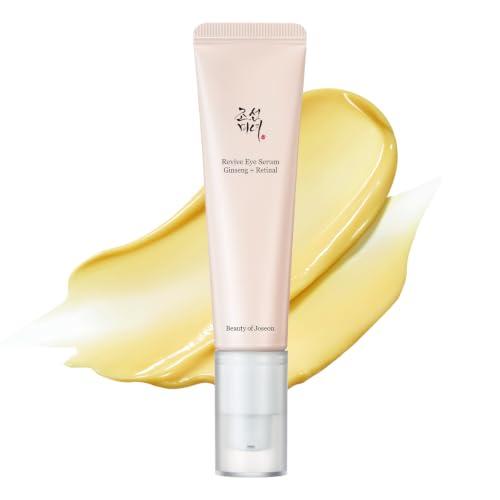
| Beauty of Joseon Revive Eye Serum | Texture, if you want a retinal at this price | 1.01 fl oz | None disclosed | Retinal + niacinamide |
That last row is the one to read carefully. It is the largest bottle on the page and the nicest to apply, and it contains no disclosed ceramide at all— it is a retinal and niacinamide serum. It is ranked last here because this is a ceramide site and that is the criterion, not because it is a bad product. If a gentle retinal is what you actually want around your eyes, it is the only thing in this band offering one.
Do you need a dedicated eye cream at all?
Often not, and we would rather say so than sell you a fifth step. Eyelid skin is thinner and has fewer oil glands than the rest of the face, so it does dry out faster — but a fragrance-free ceramide moisturizer you already own will do the same job for most people, and our guide to using a ceramide moisturizer around your eyes covers when that is fine and when it is not. The two cases where a dedicated product earns its place: you want a targeted active (caffeine for puffiness, a retinoid for crepiness) without putting it on your whole face, or your regular moisturizer migrates and stings. At under $20 the decision is cheap either way, which is most of this band's appeal.
What the price cliff is really made of
It is worth being precise, because “expensive eye cream is a scam” is as lazy a claim as the marketing it replaces. The $45-plus tier on this shelf is mostly buying three things. A prescription-adjacent active, properly encapsulated and stabilized, which is genuine formulation work and genuinely costs money. A disclosed percentage— the premium end is more willing to publish “3% lipid complex” than the drugstore end is. And texture, which is not nothing when you are patting something onto thin skin twice a day. What it is not buying, on the evidence of these listings, is more or better-disclosed ceramides. That is the one axis where the cheap end wins outright.
What to ignore on an eye-cream label
This category carries more decorative claims per square inch of packaging than any other, and at this price band the claims are doing most of the selling. Four worth discounting.
- “De-puffing” and cooling applicators. A metal rollerball or a ceramic tip feels wonderful and does something real for about twenty minutes, because cold constricts blood vessels. It is a temporary vascular effect, not a formulation benefit, and a cold spoon achieves it for free. None of the picks here depends on one.
- “Clinically proven” without a published study. The phrase is unregulated and usually describes a small, brand-run consumer-perception survey rather than a controlled trial. We do not count it as evidence, and we have not repeated any of it as fact on this page.
- Percentage claims on the front with no INCI position.“With 2% peptides” tells you nothing unless you can see where in the ingredient list those peptides sit. Our scoring reads the published list, not the front of the box.
- “Ophthalmologist tested.” This means the product was assessed for eye irritation, which is table stakes for anything sold for this area. It is not a performance claim and it does not distinguish one pick from another.
What is worth reading, in contrast, is dull and sits on the back: the named ceramide types, whether cholesterol or a fatty acid appears alongside them, the fragrance status, and the net weight. Those four things are what the ranking above is built on, and they are the four a shopper can check in a store in under a minute. Our guide to reading a ceramide ingredient label covers the method.
How to apply it so a small pot lasts
A 0.5 oz pot should last three to four months, and if yours is running out in six weeks you are using several times what you need. A rice grain per eye is the dose. Pat it on with your ring finger along the orbital bone rather than rubbing it into the lid itself, and let it settle before sunscreen or concealer goes over the top — how long to wait between skincare steps has the timing. If it pills under makeup, that is usually too much product rather than the wrong product.
When you should cross the cliff and spend more
We have spent this page arguing that the cheap end wins on lipids, and that is what the listings support. But there are three situations where the money above the band buys something this one genuinely cannot, and pretending otherwise would be the same marketing dishonesty in the opposite direction.
- You want a retinoid around your eyes and you want it handled properly. Encapsulation and buffering are real formulation work, and the eye area is the least forgiving place to get a retinoid wrong. The Beauty of Joseon serum in this band offers a retinal at a low price, but the dedicated encapsulated-retinol eye creams sit above $45 for a reason. Start with ceramides and retinol together before you buy either.
- You want a published percentage rather than an ingredient position.The premium tier is markedly more willing to state “3% lipid complex” on the label. If you want a number instead of an inference, you have to pay for the brand that prints one.
- You have tried the drugstore options and your skin did not get on with them. Tolerance is individual and it is not a function of price in either direction. If three cheap pots in a row stung or pilled, a different formulation philosophy is a reasonable next step rather than a fourth near-identical one.
What is noton that list is “my under-eyes are very dry”. That is the case this band handles best, and our top pick handles it better than anything above it.
What we left out, and why
Three products we rank on the main eye-cream roundupare missing here purely on price: the Skinfix Triple Lipid Eye Treatment, the First Aid Beauty Ultra Repair Retinol Eye Cream and the Medik8 Crystal Retinal Ceramide Eye 3 all sit well above the band. The Skinfix one in particular is the only eye product we track that publishes the complete ceramide-cholesterol-fatty-acid trio at a stated percentage, so if the published spec sheet is what you care about and the budget is not the constraint, it is the one to look at. We also left out the capsule and ampoule formats entirely, because they are sold by count rather than volume and there is no honest way to put them in a cost-per-ounce column next to a pot — those are ranked on the best ceramide eye serums instead.