Review · La Roche-Posay
La Roche-Posay Lipikar Balm AP+M Review
One of the best-selling body balms in the pharmacy aisle, and one of the most misunderstood. It is excellent at soothing itchy, eczema-prone skin - it is not the ceramide cream most buyers think they are getting.
#ad Ceramide Club is reader-supported. If you buy through our links we may earn a commission, at no cost to you — it never changes our verdict. How this works.
The verdict
A hugely popular eczema-prone body balm — but be honest about what it is: a niacinamide-and-shea barrier balm, not a ceramide showcase.
- Best for
- Eczema-prone body skin (barrier balm)
- Ceramides
- Not ceramide-led (niacinamide + shea + glycerin)
- Size
- 13.5 oz
$22.999% off≈ $1.55/oz
Price as of October 23, 2026. Prices change — Amazon's is the one that counts.
#ad · we may earn a commission from this link to La Roche-Posay Lipikar Balm AP+M
What it is
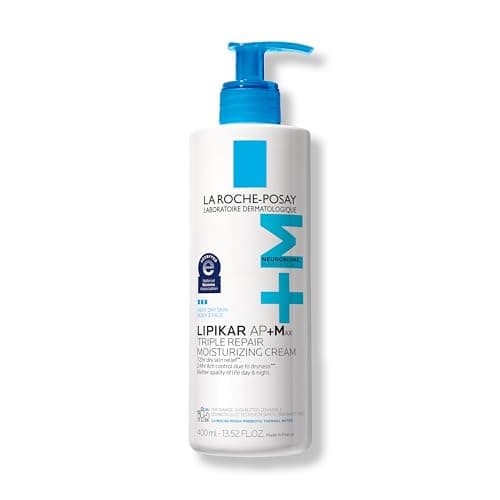
Lipikar Balm AP+M is La Roche-Posay's flagship body balm for dry, itch-prone and eczema-prone skin, sold in a large tube and intended for daily, whole-body use on adults, children and babies. On Amazon the current listing title reads “Lipikar AP+Max Triple Repair Moisturizing Body Cream”; the tube in most pharmacies says Lipikar Balm AP+M. Same product line, and worth knowing before you worry that you have the wrong one. It is positioned a clear step above a drugstore lotion in both texture and price: thick, cushiony, fast to disappear for something this rich, and formulated without fragrance.
It is also, consistently, the product readers arrive at this site already holding. It is the one a pharmacist recommends, the one that turns up in dermatologist shelf-talkers, and the one people search for alongside the phrase “barrier repair”. That is why this review exists, and why the most useful thing it can do is be precise about what the formula contains.
The ingredient decode — and the thing most buyers get wrong
The headline ingredients La Roche-Posay builds Lipikar around are niacinamide, shea butter, glycerin and the brand's prebiotic thermal water. All four are doing real work. What Lipikar is not built around is a disclosed ceramide blend — it does not name Ceramide NP, AP or EOP the way CeraVe names ceramides 1, 3 and 6-II, and it does not advertise the cholesterol-plus-fatty-acid pairing that the lipid literature treats as the point of the exercise. If you bought it believing you were buying a ceramide cream, you were buying something else that happens to be good.
That distinction matters because the mechanism behind barrier repair is specific. The study on optimal ratios of topical stratum corneum lipids found that recovery depends on applying ceramides, cholesterol and free fatty acids together in roughly physiological proportion — an incomplete mixture is not simply a weaker version of the same thing. So a formula that leads on niacinamide and shea is playing a different game: soothing, occluding, reducing water loss from the surface, and supporting the barrier indirectly rather than restocking its lipids directly.
The niacinamide side of that is genuinely well supported. Work on niacinamide and stratum corneum hydration and structure shows measurable barrier benefit from the ingredient in its own right, which is why we score Lipikar highly on barrier support and tolerance while scoring it low on ceramide profile. Both numbers are honest; they are measuring different things. Our scoring rubric is published on how we review, and this product is a good example of why we separate those axes rather than publishing one blended star rating.
How it performs
On the thing it is sold for — itchy, reactive, eczema-prone body skin — it is very good. The texture is the main reason. It is thick enough to leave a real layer on dry shins and the backs of arms, but it breaks down and absorbs faster than a petrolatum ointment, so people actually apply it twice a day instead of once and then giving up. It is fragrance-free, which matters more than most shoppers realize: skin with a compromised barrier lets more of everything through, and fragrance is the single most common avoidable irritant in body care. In our experience of the category, the combination of “rich enough to matter” and “pleasant enough to repeat” is rarer than it should be, and it is the strongest argument for paying La Roche-Posay's price.
Where it struggles is warm weather and large surface areas. It is a balm; on a humid day across a whole torso it feels like one. And while the tube is large, the cost-per-ounce is several times what a 20 oz drugstore ceramide pump costs, which matters because body care is consumed by volume. The price shown on this page is pulled live from the current listing with a cost-per-ounce computed from it, so you can see that gap yourself rather than taking our word for it.
Who it's for
Buy it if the dominant symptom is itch rather than flaking: eczema-prone skin, the scratch-at-night kind of dryness, children's dry patches, or skin that reacts to products often enough that you have started reading ingredient lists defensively. It is also a sensible choice for anyone who has already failed on cheaper lotions because they were too thin to hold overnight. Ceramide deficiency is well documented in atopic skin — the review of ceramide abnormalities in atopic dermatitis sets out why — and emollients of this kind are standard supportive care alongside whatever a clinician has prescribed, not a replacement for it.
Skip it if what you specifically want is ceramides. That is not a knock on the product, it is a mismatch between the product and the shopping intent, and it is the most common reason someone is disappointed by a tube that is objectively well made. Skip it too if you are moisturizing a whole adult twice daily on a budget — the math does not work at this price per ounce.
Alternatives, honestly
If you want the disclosed lipid list, the CeraVe Moisturizing Creamnames three ceramide types plus cholesterol, comes in a 19 oz tub, and costs a fraction as much per ounce — it is the top pick on our barrier-repair body ranking for exactly that reason. If you want the lowest running cost for daily whole-body use, the Curel Ultra Healing Lotion is a 20 oz fragrance-free pump. If the skin is rough and scaly rather than itchy, a urea formula like the Eucerin Advanced Repair Creamdoes smoothing work no plain emollient can. And if you want Lipikar's texture with an actual named ceramide in it, the Illiyoon Ceramide Ato Lotion on the same ranking discloses Ceramide NP with cholesterol.
For eczema specifically, where itch and barrier damage arrive together, our full picks are on the best ceramide body lotions for eczema-prone skin, and the mechanism is in ceramides for eczema.
The verdict
Lipikar Balm AP+M is a very good product mis-shelved by the internet. As a soothing, fragrance-free, well-tolerated balm for itchy and eczema-prone body skin it is worth its price, and the texture is the specific thing that justifies paying above drugstore rates. As a ceramide cream it does not compete, because it is not one — and anybody telling you otherwise has not read the ingredient list. Buy it for the itch. Buy something lipid-led for the barrier. Owning both is not extravagant if you have eczema-prone skin; they are doing two different jobs. The American Academy of Dermatology's dry-skin guidance covers the habits that make either one work better: shorter, cooler showers, and moisturizer within minutes of toweling off.
What we like
- A genuinely effective, well-tolerated balm for itchy, eczema-prone body skin
- Large tube and a reasonable cost-per-ounce for a dermatologist-shelf balm
- Niacinamide, shea, and prebiotic thermal water make a soothing, occlusive barrier layer
What we don't
- This is the honest part: Lipikar leans on shea and niacinamide, not a disclosed ceramide blend — if ceramides specifically are your goal, it is the wrong pick
- Rich enough that it can feel heavy in warm weather
Don't buy this if…
…you specifically want ceramides. Lipikar is an excellent barrier balm, but it is not built around ceramides — for that, the Eucerin ceramide-and-urea creams or a Curel lotion are the on-target body choices.
Frequently asked
Questions people actually ask
Does La Roche-Posay Lipikar Balm contain ceramides?
Not as a disclosed, named blend. La Roche-Posay builds Lipikar around niacinamide, shea butter, glycerin and its prebiotic thermal water rather than publishing specific ceramide types the way CeraVe lists ceramides 1, 3 and 6-II. It is a barrier balm, but it is not a ceramide showcase — which is the single most common misunderstanding about it.
Is Lipikar Balm AP+M the same as Lipikar AP+Max?
They are the same product line; the naming differs between the tube and the current Amazon listing title, which reads “Lipikar AP+Max Triple Repair Moisturizing Body Cream”. If you are comparing a pharmacy tube to an online listing and the names do not match exactly, that is why.
Can you use Lipikar Balm on your face?
You can, and plenty of people with very dry skin do, but it is formulated and sized as a body balm and it is rich for daily facial use. The general question is covered in can you use body lotion on your face, and for the face we would reach for a disclosed-ceramide cream instead.
Is Lipikar good for eczema?
It is one of the better over-the-counter emollients for eczema-prone skin: fragrance-free, well tolerated, soothing, and thick enough to hold overnight. Treat it as supportive care alongside anything a clinician has prescribed rather than as a treatment on its own, and see a professional if skin is weeping, cracked and bleeding, or spreading.
Is Lipikar worth the price over a drugstore lotion?
For itch and reactivity, often yes — the texture and tolerance are what you are paying for. For barrier lipids specifically, no: a 19 oz tub of three-ceramide cream delivers more of what the lipid research points at, for a fraction of the cost per ounce. Which answer applies depends entirely on your dominant symptom.
Keep reading
Related on Ceramide Club
- The best barrier repair body lotionsWhere this balm places, and what beats it on lipids.
- Best ceramide body lotions for eczema-prone skinThe itch-first ranking this belongs to.
- CeraVe Moisturizing Cream reviewThe disclosed-ceramide benchmark, far cheaper.
- Ceramides for eczema-prone skinWhy atopic skin runs short on ceramides.
Show your work
Sources
- Man MQ et al. — Optimal ratios of topical stratum corneum lipids improve barrier recovery (PubMed)
- Niacinamide and its impact on stratum corneum hydration and structure (Scientific Reports)
- Ceramide abnormalities in atopic dermatitis: pathogenic and therapeutic implications (NCBI/PMC)
- American Academy of Dermatology — Dermatologists' top tips for relieving dry skin
- Cleveland Clinic — What ceramides do for your skin
- La Roche-Posay La Roche-Posay Lipikar Balm AP+M — ingredient list, Amazon product listing