Review · Eucerin
Eucerin Advanced Repair Lotion Review
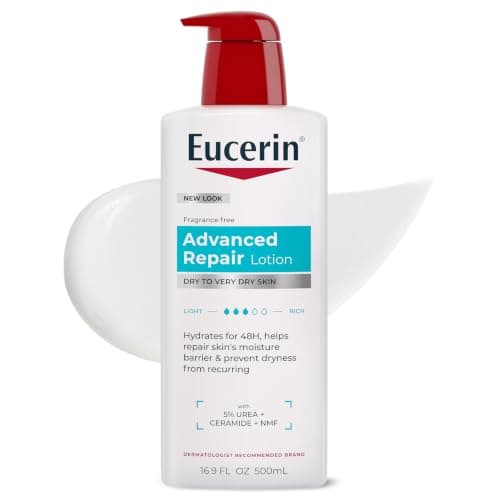
Ceramide-3 plus urea in a lighter, fast-absorbing pump lotion — the everyday-maintenance sibling of the jar cream, for keeping very dry skin comfortable day to day.
#ad Ceramide Club is reader-supported. If you buy through our links we may earn a commission, at no cost to you — it never changes our verdict. How this works.
The verdict
The lighter, pump-bottle version of the Advanced Repair cream — same ceramide-and-urea idea, faster absorption for everyday use.
- Best for
- Everyday very-dry-skin maintenance
- Ceramides
- Ceramide-3 (NP) + urea
- Size
- 16.9 oz
$14.9915% off≈ $0.76/oz
Price as of Sep 14, 2026. Prices change — Amazon's is the one that counts.
#ad · we may earn a commission from this link to Eucerin Advanced Repair Lotion
What it is
Eucerin Advanced Repair Lotion is the lighter, pump-bottle version of the brand's well-liked Advanced Repair jar cream. It uses the same core idea — ceramide-3 (NP) paired with urea— but in a faster-absorbing lotion in a generous 16.9-ounce pump, built for everyday whole-body maintenance rather than heavy spot-repair. It is fragrance-free. Where the jar cream is the pick for genuinely rough, scaly skin, this is the one you reach for daily to keep very dry skin from getting there in the first place.
The ingredient decode
Two ingredients are doing the work, and they complement each other. The ceramide-3 restocks one of the lipids your barrier is built from, the standard barrier-repair logic. The differentiator is the urea: urea is a humectant, meaning it draws water into the skin, and the reference on how moisturizers work places it in that humectant family alongside glycerin. At the levels used in a lotion like this it also helps soften rough, dry skin over time, which is why the ceramide-and-urea combination handles stubborn dryness better than a plain lotion. For the background on what the ceramide side is contributing, Cleveland Clinic's overview is the companion read. The honest limitation on the ingredient sheet is that this discloses a single ceramide type, where the three-ceramide drugstore picks list more — so if maximum ceramide disclosure is your priority, this is not built to win that contest. It earns its place on the urea and the value, not on ceramide count.
How it feels
It is noticeably lighter and faster to absorb than the jar cream, which is the entire reason to pick the lotion. The pump makes daily, whole-body use quick and hygienic — a real advantage over dipping into a jar — and it does not leave the heavy film a thick balm does. The trade is that the lighter body means it holds less on the very worst, roughest patches than the cream version.
Who it's for
Anyone keeping very dry body skin comfortable on a daily basis: arms, legs, and torso through a dry winter, or year-round if your skin runs dry. The fast absorption and pump format make it easy to actually use every day, which is what maintenance depends on. It sits among our body lotions for dry skin and in the wider ceramide body lotion roundup. Think of it as the everyday workhorse, with the jar cream held in reserve for the roughest days or patches.
Who should skip it
Two honest cautions. First, urea can sting on cracked or broken skin, so if you have open cracks or raw patches, leave this off them — use a plain fragrance-free barrier balm until the surface heals, then switch back. Second, if your dry skin is severe and genuinely rough and scaly, the maintenance lotion may not be enough; that is exactly the job the richer Eucerin Advanced Repair Cream is built for, either instead of this or added on the worst areas. And if you want the most ceramides per dollar rather than the urea angle, a three-ceramide drugstore lotion is the more on-target buy.
The value case
This is a strong value pick for body care. A large pump bottle at a low cost-per-ounce is exactly what you want in a lotion you apply generously over big areas every day — body care is where cost-per-ounce matters most, because you use so much of it. You are not paying for a long ceramide list; you are paying for a sensible ceramide-and-urea formula in a big, convenient format at a fair price. For everyday very-dry-skin maintenance, that is the right kind of value.
Alternatives
Need more for rough, scaly patches? Step up to the Eucerin Advanced Repair Cream, the richer jar version of the same idea. Curious how the urea approach compares with leading purely on ceramides? Our ceramides vs urea comparison lays out the trade-off. And for the full field of everyday body options, the dry-skin body picks put this in context.
What we like
- Same ceramide-3-and-urea approach as the cream in a fast-absorbing lotion
- Pump bottle is convenient and hygienic for daily whole-body use
- Low cost-per-ounce for a barrier-supporting body lotion
What we don't
- Lighter than the jar cream, so very rough patches may want the thicker version
- Single disclosed ceramide type
Don't buy this if…
…your dry skin is severe and rough. The lotion is the maintenance version — step up to the jar cream (or add it on the worst patches) when skin is really struggling.
Frequently asked
Questions people actually ask
How is the lotion different from the Eucerin Advanced Repair Cream?
Same core idea — ceramide-3 plus urea — but the lotion is lighter and faster to absorb, in a convenient pump for daily whole-body maintenance. The jar cream is richer and better for genuinely rough, scaly patches.
Can I use it on cracked skin?
Be careful — urea can sting on cracked or broken skin. Keep it off open cracks, use a plain fragrance-free barrier balm there until the surface heals, then switch back once the skin is intact.
How many ceramides does it have?
It discloses one — ceramide-3 (NP). Its real differentiator is the urea rather than a long ceramide list, so if maximum ceramide disclosure is your priority, a three-ceramide drugstore lotion is the more on-target choice.
Keep reading
Related on Ceramide Club
Show your work